ABEK2 P3 filter (A2B2E2K2P3)
ABEK2 P3 (also written ABEK2P3, and in full A2B2E2K2P3) is a combined filter: the letters A, B, E and K protect against four families of gases and vapours (organic, inorganic, acid and ammonia) at class 2, meaning up to 0.5% by volume, and P3 stops dust, fumes and mists at the highest efficiency. Spasciani calls it 203 A2B2E2K2P3 and makes it with the EN 148-1 screw thread.
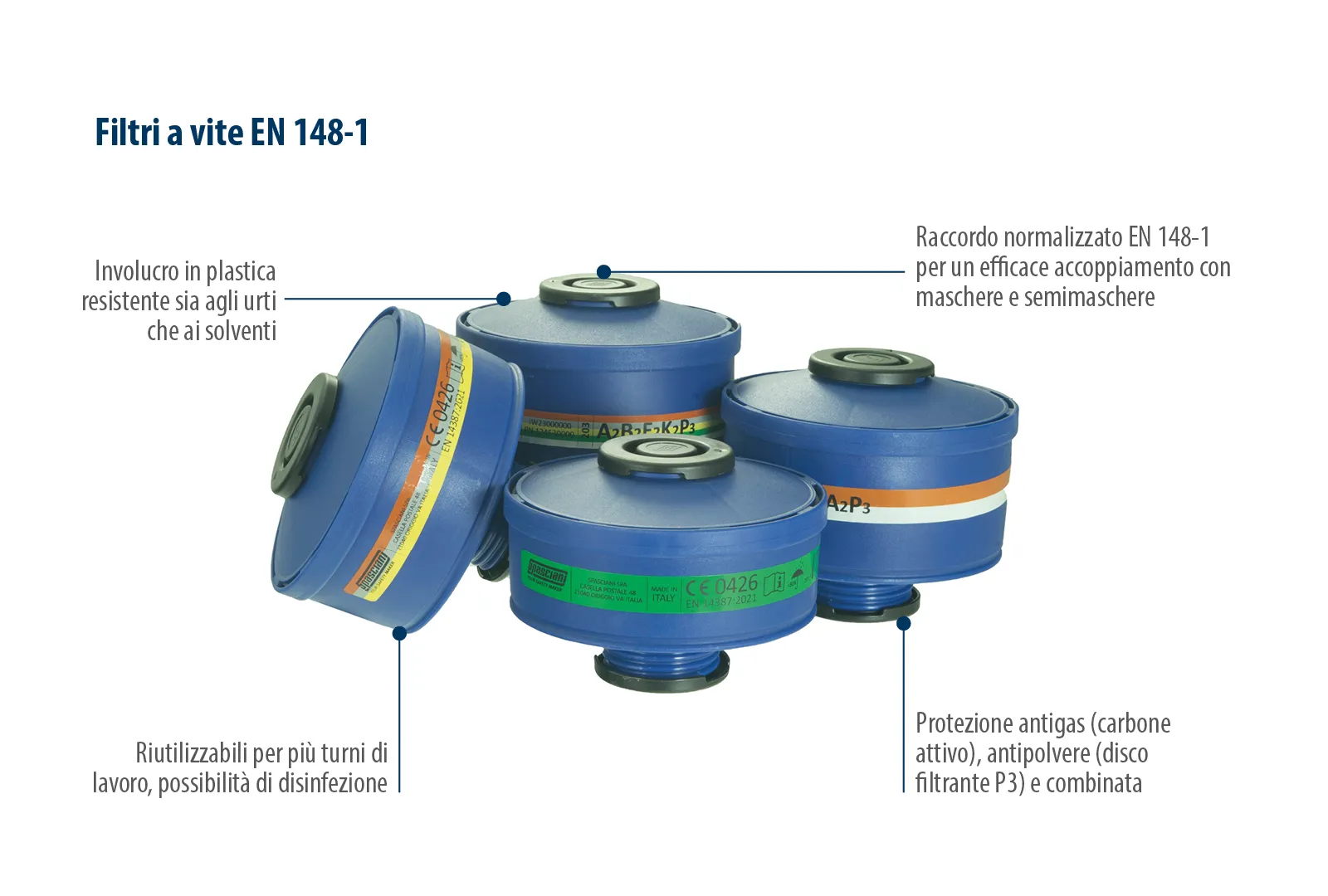
ABEK2 P3, ABEK2P3, A2B2E2K2P3: one filter, three spellings
EN 14387 writes the class after each letter: A2 B2 E2 K2, plus P3 for particles. Since all four gas letters here are class 2, people shorten it: ABEK2, then P3. With or without a space, it is the same.
Spasciani calls it 203 A2B2E2K2P3: 203 is the model (the filter's height), the rest is the full code. On Bayora you find it under that name.
Not to be confused with
| Filter | Difference from ABEK2 P3 | Price |
|---|---|---|
| ABEK2 P3Spasciani 203 A2B2E2K2P3 | This one. | €30.13 |
| ABEK2Spasciani 202 A2B2E2K2 | Same gases, but no P3: it does not stop dust, fumes or mists. | €24.16 |
| ABEK2 Hg P3Spasciani 203 A2B2E2K2 Hg P3 | Also protects against mercury vapour. | €34.89 |
| ABE2 K1 P3 FormaldeideSpasciani 205 A2B2E2K1 P3 R D FORMALDEIDE | Formaldehyde version, with ammonia at class 1. | €32.09 |
| A2 P3Spasciani 202 A2P3 | Organic vapours and particles only: no chlorine, acid gases or ammonia. | €27.33 |
What about ABEK1 P3 (A1B1E1K1P3)? Same letters, but class 1: lower capacity, up to 0.1% by volume. Spasciani makes it as a cartridge for the 2000 series half masks, not as a screw-in filter.
What it protects against
| Code | Family | Examples |
|---|---|---|
| A2 | Organic gases and vapours boiling above 65 °C | solvents, thinners, paints |
| B2 | Inorganic gases and vapours, except carbon monoxide | chlorine, hydrogen sulphide, hydrogen cyanide |
| E2 | Acid gases | sulphur dioxide, hydrogen chloride |
| K2 | Ammonia and its organic derivatives | livestock housing, refrigeration plants |
| P3 | Particles: dusts, fumes and mists, highest efficiency | asbestos, silica, spray mists |
When to use it
It is the filter to choose when the air carries more than one substance, or when you do not know for sure which: chemical industry and laboratories, water treatment, industrial cleaning with chlorine and ammonia, emergency teams, and the mask kept at home for emergencies. For a job with a single known hazard (the solvents of a body shop, for instance) a targeted filter such as A2P3 lasts longer and breathes more easily.
How long it lasts
Sealed, until the date printed on the casing. In use, change it when you smell or taste the substance or when breathing gets hard; for continuous use the employer sets the interval in advance.
Which mask
It screws onto the Spasciani TR 2002 full face mask and any other mask with an EN 148-1 connector. You need one: the TR 2002 has a single connector.
What it does not protect against
- Carbon monoxide: no ABEK filter stops it. In a fire it is the first danger.
- Air with less than 17% oxygen, and confined spaces such as wells, tanks and slurry pits: there you need a self-contained breathing apparatus.
- Organic compounds boiling below 65 °C, such as acetone: you need AX filters.
- Mercury vapour: you need the Hg version (203 A2B2E2K2 Hg P3).
Frequently asked questions
Are ABEK2P3, ABEK2 P3 and A2B2E2K2P3 the same filter?
Yes. A2B2E2K2P3 is the full code, with the class after each letter; ABEK2P3 and ABEK2 P3 shorten it because the four gas letters share the same class, 2. Spasciani sells it as 203 A2B2E2K2P3.
What is the difference between ABEK1 and ABEK2?
The class: the number says how much the filter holds. Class 1 is used up to 0.1% gas by volume, class 2 up to 0.5%. The letters, meaning the gas families, are the same.
Does the ABEK2 P3 filter fit any mask?
It fits masks with the EN 148-1 screw thread, often called the 40 mm thread: the Spasciani TR 2002, TR 82 and the ST 85 half mask. It does not fit bayonet or proprietary connectors.
Does it protect against fire smoke?
No. Smoke contains carbon monoxide, which no ABEK filter stops, and a fire may lack oxygen. Fires require self-contained breathing apparatus.
How often do you change it?
Sealed, it lasts until the date printed on the casing. In use, change it when you smell or taste the substance or when breathing gets hard; for continuous use the employer sets the interval in advance.