Gas mask for chemical plants, laboratories and water treatment
Where different chemicals are transferred, dosed or sampled, the hazard changes from one area to the next: solvents, chlorine, acids, ammonia. The multi-gas ABEK2 P3 filter covers the four commonest gas families and mists.
The gas families
A for organic solvents, B for chlorine, hydrogen sulphide and hydrogen cyanide, E for sulphur dioxide and hydrogen chloride, K for ammonia and amines. The 2 is the class: medium capacity, up to 0.5% by volume.
Water and wastewater treatment
Plants involve chlorine and hypochlorite (B), acids for pH correction (E), ammonia (K) and hydrogen sulphide from tanks (B). Tanks and wells, however, are confined spaces: never enter them with a filter.
When you need another filter
Mercury: you need the Hg version (203 A2B2E2K2 Hg P3). Solvents boiling below 65 °C, such as acetone or dichloromethane: you need AX. Carbon monoxide: no ABEK filter stops it.
What remains the employer's job
The employer chooses PPE through the risk assessment, and a full face mask is category III PPE: training and a filter change plan are required.
The filter to start from
ABEK2 P3Spasciani 203 A2B2E2K2P3
With several substances in the same area, or in an emergency where you do not know what has been released, ABEK2 P3 covers the most in a single filter.
The filter shown is a starting point: the substance's safety data sheet, and at work the risk assessment, have the final word.
Other jobs
Limits and warnings
- The filter does not protect below 17% oxygen or with unknown, high gas concentrations: then you need self-contained breathing apparatus.
- An opened gas filter runs out even when not in use.
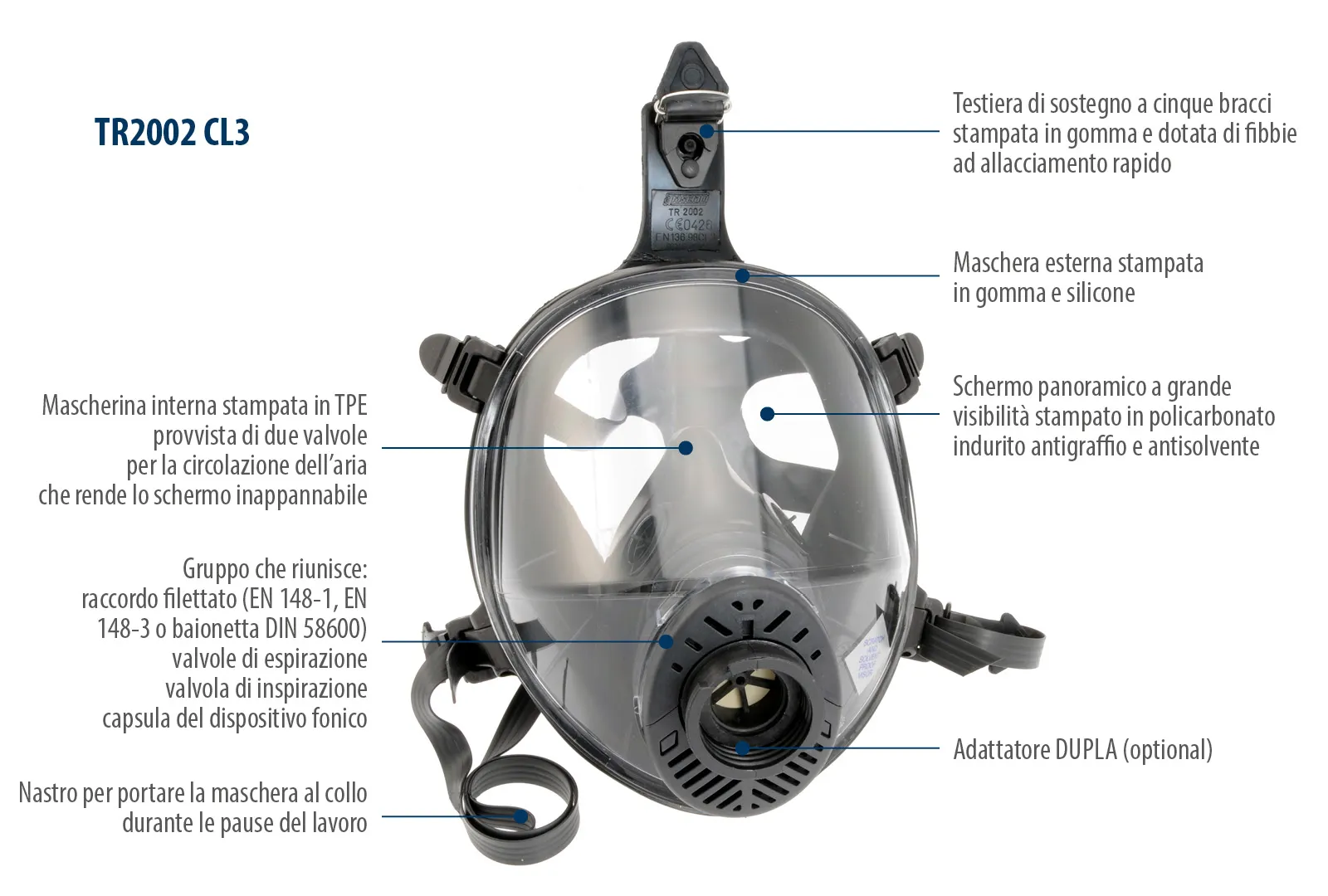
- The TR 2002 takes one filter at a time: filters are not combined.